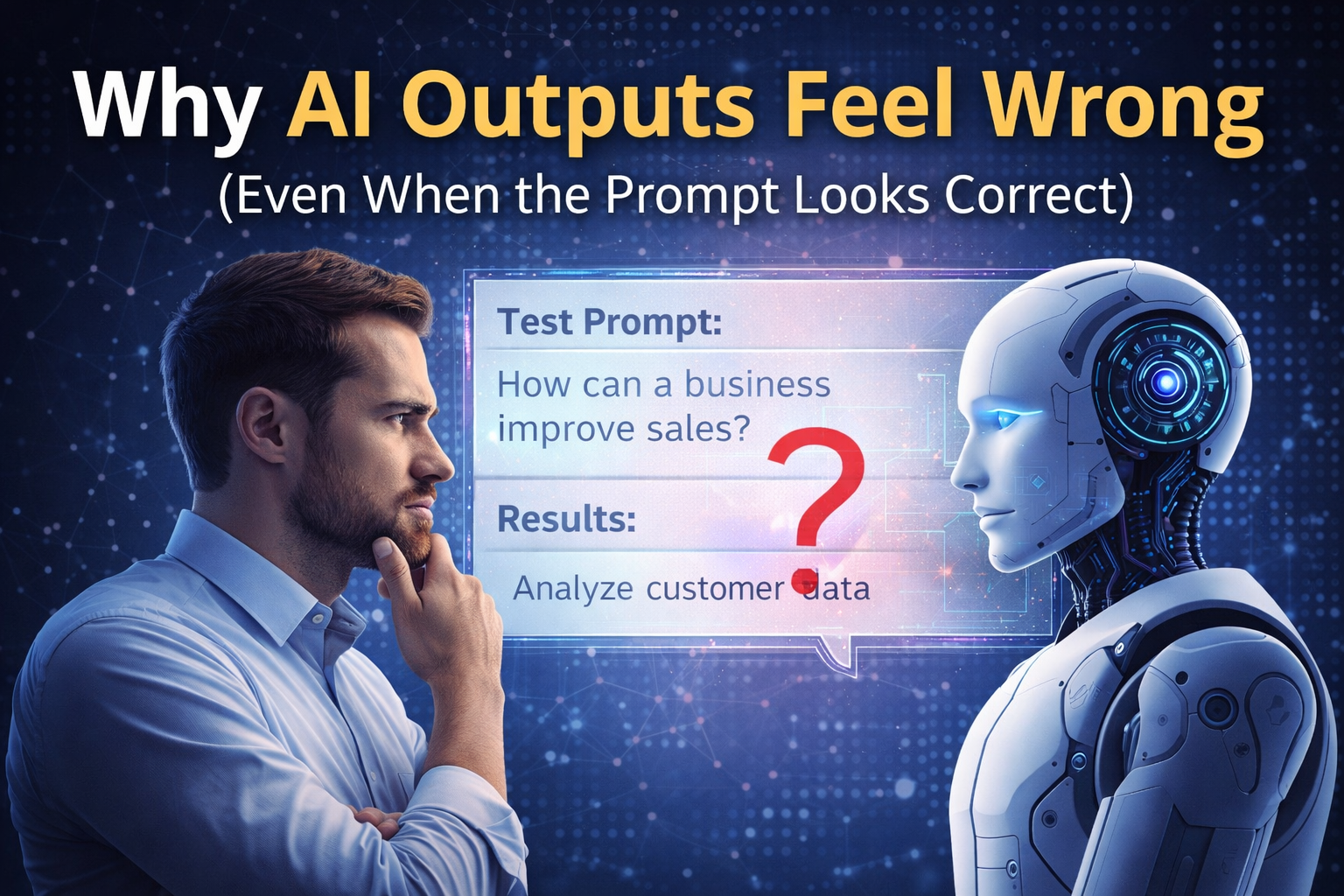

Why AI Outputs Feel Wrong (Even When the Prompt Looks Correct)
You write a prompt carefully.
You explain what you want.
You press enter.
And the answer comes back…
Technically correct.
But practically useless.
If this feels familiar, you’re not alone.
The real problem isn’t your prompt
Most people assume that when AI gives a weak or strange answer, the prompt must be bad.
In reality, the issue is usually missing context, not bad wording.
AI doesn’t understand situations the way humans do.
It doesn’t know:
- Your standards
- Your experience level
- Your real goal behind the question
- What “good” looks like in your work
Why correct prompts still fail
Even a well-written prompt can fail because AI only reacts to what is explicitly stated.
Anything you don’t say, AI will silently guess.
And those guesses are where things go wrong.
AI doesn’t reason — it mirrors
AI doesn’t think strategically.
It mirrors the clarity of the input it receives.
If your prompt lacks structure, priorities, or constraints, the output will feel:
- Generic
- Overconfident but slightly off
- Almost useful — but not quite
How to fix the problem
Instead of asking better questions, start giving better context.
Before every prompt, define:
- What you’re trying to achieve
- Who the output is for
- What should be avoided
- What success looks like
When context becomes clear, AI output suddenly feels aligned.
Final thought
AI isn’t broken.
Your prompt probably isn’t either.
What’s missing is the invisible layer of human intent.
Once you make that explicit, AI starts working with you — not against you.